
Myopia Control

What is Myopia?
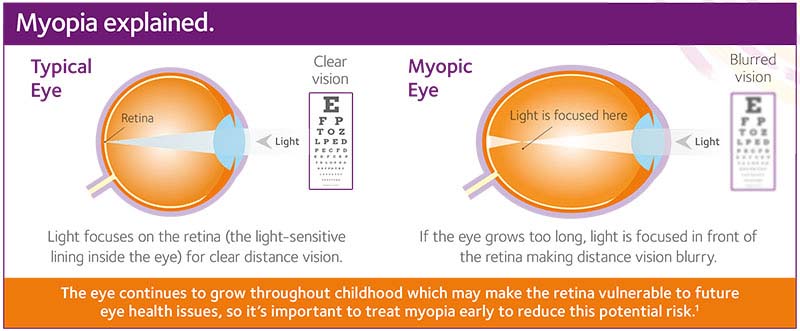
Often referred to as nearsightedness, myopia occurs when the eye grows longer than normal, or the cornea is too curved. As a result, light rays focus in front of the retina versus on the retina, causing distance images to be blurry. Images up close remain clear.
Myopia can be categorized as mild (~1.00 diopters), moderate, or high (greater than -5.00 diopters).
Causes
On average, myopia is first detected in children between the ages of 6 to 12 years old, and evidence suggests a genetic component. There is a 25% chance that a child will develop myopia if one parent has myopia and increases to 50% if both parents have myopia.
Environmental and lifestyle conditions may also accelerate myopia development. Many have attributed excessive time on small digital devices as a contributor to myopia. Per a recent Taiwanese study, sunlight, time outdoors, and sporting activities were found to be ways of slowing the onset of myopia.
Symptoms
Some of the signs and symptoms of myopia are:
Eyestrain or headaches
Squinting to see properly, sitting in the front row during class, or excessive blinking
A decline in educational performance
Parental vigilance is critical; if your child is becoming unengaged or is struggling in school, it could identify a potential vision problem such as myopia.
Risks
Later in life, with abnormally long eyes, analysis shows increased risks for retinal detachment, glaucoma, cataracts, and myopic maculopathy.
Treatment
Contact lenses and glasses are the most common methods for addressing symptoms of myopia by refocusing light onto the retina.
Myopia management uses various evidence-based therapies and lifestyle modifications to slow down myopia progression. Our doctors will advise you on the best treatment for vision and eye health, for you or your child.
Why Myopia Management?
We at Vision Source InSight Eyecare do not want to just correct nearsightedness, but also optimize the long-term vision and health of people with myopia.
What is the cost? The consultation fee is $100, which includes scans, risk factor assessment, and discussion over goals to create individualized therapy. Sometimes, we do not immediately start therapy and instead, we monitor with office visits for changes in prescription and eye length. If treatment is started, the $100 consultation fee can be applied towards the myopia management program cost—the fee for 12 months of monitoring is estimated at $300.
Atropine Eye Drops
Atropine eye drops are low-concentration eye drops made through a specialty pharmacy.
How do they work? The drops are instilled into the eyes each night, slightly dilate the pupil, and relax the eyes’ focusing mechanisms. Research shows these drops reduce myopia progression in children. One of the side effects of this medication is light sensitivity; therefore, transition or photochromic glasses, and sunglasses, are strongly recommended. The patient is seen every 3-6 months to monitor the effectiveness of the therapy.
What is the cost? Myopia management progress visits total $800 for one year. In addition to therapy follow-up visits, fees for the atropine drops will be paid directly to the pharmacy. Standard rates of the atropine drops are $40 - $50 per month, depending on the strength prescribed. In some instances, due to unique circumstances, the atropine drops may incur a fee of $150 per month; fees associated with the medication are subject to change, at the discretion of the pharmacy. The fees are recurrent annually, as the patient will need to continue therapy throughout childhood.
Hard Specialty Night Contact Lenses/Ortho-K/Corneal Retainer Contact Lenses
Orthokeratology (Ortho-K) is becoming an increasingly popular method for treating myopia. Our office has been prescribing Ortho-K Contact Lenses since 2005.
How do they work? Ortho-K uses gas-permeable contact lenses to reshape the cornea, reducing myopia and its rate of progression as you or your child sleeps. They work in a similar way for the eyes as dental retainers work for the teeth. These “nighttime retainers” provide vision correction that lasts through the day without the need for daytime eyeglasses or contact lenses. The effect is temporary, so Ortho-K is worn every night, but this therapy is reversible.
What is the cost? Within the first 3 months, several progress visits and scans of the eye will be done so that the doctor can get the fit and prescription of the lenses exact. Fees range between $2000 - $2600+ for the first year and $1000 - $1300+ for the following years. The fee includes all progress visits and a new pair of lenses for the year. The cost for the first year is higher due to more visits, scans, the complexity of your eyes (prescription, eye shape, and eye health), and time spent designing; however, cost decreases during subsequent years if few changes are needed.
Soft Multifocal Contact Lenses
Some soft multifocal contact lenses are specially designed to slow myopia progression and are worn like standard soft contact lenses that you or your child may already be wearing.
How do they work? Differing powers are arranged in rings on the contact lens; the center portion focuses light directly on the retina so that distance vision is clear, and the outer portion adds more power to focus in front of the peripheral retina. Studies have shown this contact lens design slows eyeball elongation.
What is the cost? Fees range from $1500 - $1700+ each year, which depends on the complexity of your eyes. The fee includes all progress visits and a supply of lenses for the year.
Interested in Learning More?
Visit mykidsvision.org to learn more about myopia and myopia management therapies.


Contact Info
Hours of Operation
- Monday 9:00am - 5:30pm
- Tuesday 9:00am - 7:00pm
- Wednesday 9:00am - 5:30pm
- Thursday 9:00am - 5:30pm
- Friday 9:00am - 5:30pm
- Saturday Closed
- Sunday Closed

© 2026 Vision Source InSight Eyecare. All rights Reserved. Accessibility Statement - Privacy Policy - Sitemap
Managed & Designed By:
